Comparing the best AI sales assistant? An AI sales assistant is software that uses machine learning to help you get more done — it lowers the barrier so anyone can produce professional output. Privacy matters too: check whether your data trains the model and whether a no-log or enterprise tier is available. Whether you are a beginner or a pro, the right AI sales assistant slots into your workflow and pays for itself fast. We tested the leading options and ranked them by quality, value, and ease of use.
Scroll (web service)
Scroll was a subscription-based web service developed by Scroll Labs Inc., offering ad-free access to websites in exchange for a fee. Scroll was not an ad blocker; instead, it partnered directly with internet publishers who voluntarily removed ads from their sites for Scroll users in exchange for a portion of the subscription fee. In May 2021, Scroll was acquired by Twitter. In October 2021, Scroll sent out an email announcing its integration into Twitter Blue within 30 days. == Functionality == Scroll enabled users to browse websites that partnered with Scroll without encountering online advertising, in exchange for a subscription fee. Unlike ad blocker, which disable advertisements without compensating the publisher, Scroll sent a browser cookie indicating that the user was a subscriber. The Scroll software integrated into the website detected this cookie and served an ad-free version of the site. In exchange for disabling advertisements, partner websites received a portion of the subscription fee. As of January 2020, Scroll retained 30% of the subscription fee, with the remaining 70% distributed among publisher sites. Payments to sites were made individually by users based on their 'engagement and loyalty,' rather than from a single pool of all subscription revenue. Scroll did not grant subscribers access to partner sites behind a paywall; it only removed ads from the site if the user also paid the publication's subscription fee. == History == Scroll was founded in 2016 by former Chartbeat Chief Executive Tony Haile. Scroll raised US$3 million in its first round of funding in 2016, including investments from The New York Times, Uncork Capital, and Axel Springer SE. By October 2018, Scroll had raised US$10 million in funding. In 2018, Scroll signed its first partner websites, which included The Atlantic, Fusion Media Group, Business Insider, Slate, MSNBC, The Philadelphia Inquirer, and Talking Points Memo. In February 2019, Scroll acquired the social media curation app Nuzzel. The same month, Mozilla and Scroll announced a partnership to run a "test pilot" together, but did not go into details. Scroll entered beta testing in 2019 and launched to the general public on January 28, 2020. In March 2020, Mozilla started offering Scroll as part of its "Firefox Better Web" service bundle. In May 2021, Scroll was acquired by Twitter, with the future of Scroll cited as being uncertain. An email to customers announcing the change said, "Later this year, Scroll will become part of a wider Twitter subscription that will expand on and adapt our services and functionality".
Afghan Girls Robotics Team
The Afghan Girls Robotics Team, also known as the Afghan Dreamers, is an all-girl robotics team from Herat, Afghanistan, founded through the Digital Citizen Fund (DCF) in 2017 by Roya Mahboob and Alireza Mehraban. It is made up of girls between ages 12 and 18 and their mentors. Several members of the team were relocated to Qatar and Mexico by humanitarian and tech entrepreneur Sarah Porter following the fall of Kabul in August 2021. A documentary film featuring members of the team, titled Afghan Dreamers, was released by MTV Documentary Films in 2023. == Origins == The Afghan Girls Robotics Team was co-founded in 2017 by Roya Mahboob, who is their coach, mentor and sponsor, and founder of the Digital Citizen Fund (DCF), which is the parent organization for the team. Dean Kamen was planning a 2017 competition in the United States and had recruited Mahboob to form a team from Afghanistan. Out of 150 girls, 12 were selected for the first team. Before parts were sent by Kamen, they trained in the basement of the home of Mahboob's parents, with scrap metal and without safety equipment under the guidance of their coach, Mahboob's brother Alireza Mehraban, who is also a co-founder of the team. == 2017 and 2018 == In 2017, six members of the Afghan Girls Robotics Team traveled to the United States to participate in the international FIRST Global Challenge robotics competition. Their visas were rejected twice after they made two journeys from Herat to Kabul through Taliban-controlled areas, before officials in the United States government intervened to allow them to enter the United States. Customs officials also detained their robotics kits, which left them two weeks to construct their robot, unlike some teams that had more time. They were awarded a Silver medal for Courageous Achievement. One week after they returned home from the competition, the father of team captain Fatemah Qaderyan, Mohammad Asif Qaderyan, was killed in a suicide bombing. After their United States visas expired, the team participated in competitions in Estonia and Istanbul. Three of the 12 members participated in the 2017 Entrepreneurial Challenge at the Robotex festival in Estonia, and won the competition for their solar-powered robot designed to assist farmers. In 2018, the team trained in Canada, continued to travel in the United States for months and participate in competitions. == 2019 == The Afghan Girls Robotics team had aspirations to develop a science and technology school for girls in Afghanistan. Roya Mahboob interfaced with the School of Engineering and Applied Sciences (SEAS), the School of Architecture, and the Whitney and Betty MacMillan Center for International and Area Studies Yale University to design the infrastructure for what they named The Dreamer Institute. == 2020 == In March 2020, the governor of Herat at the time, in response to the COVID-19 pandemic in Afghanistan and a scarcity of ventilators, sought help with the design of low-cost ventilators, and the Afghan Girls Robotics Team was one of six teams contacted by the government. Using a design from Massachusetts Institute of Technology and with guidance from MIT engineers and Douglas Chin, a surgeon in California, the team developed a prototype with Toyota Corolla parts and a chain drive from a Honda motorcycle. UNICEF also supported the team with the acquisition of necessary parts during the three months they spent building the prototype that was completed in July 2020. Their design costs around $500 compared to $50,000 for a ventilator. In December 2020, Minister of Industry and Commerce Nizar Ahmad Ghoryani donated funding and obtained land for a factory to produce the ventilators. Under the direction of their mentor Roya Mahboob, the Afghan Dreamers also designed a UVC Robot for sanitization, and a Spray Robot for disinfection, both of which were approved by the Ministry of Health for production. == 2021 == In early August 2021, Somaya Faruqi, former captain of the team, was quoted by Public Radio International about the future of Afghanistan, stating, "We don’t support any group over another but for us what’s important is that we be able to continue our work. Women in Afghanistan have made a lot of progress over the past two decades and this progress must be respected." On August 17, 2021, the Afghan Girls Robotics Team and their coaches were reported to be attempting to evacuate, but unable to obtain a flight out of Afghanistan, and a lawyer appealed to Canada for assistance regarding the evacuation of the team members. As of August 19, 2021, nine members of the team and their coaches had evacuated to Qatar. The founder of the team, Roya Mahboob, and DCF board member, Elizabeth Schaeffer Brown, were previously in contact with the Qatari government to assist the team members in their evacuation from Afghanistan. By August 25, 2021, some members arrived in Mexico. Saghar, a team member who evacuated to Mexico, said, "We wanted to continue the path that we started to continue to go for our achievements and to go for having our dreams through reality. So that's why we decided to leave Afghanistan and go for somewhere safe" in an interview with The Associated Press. The members who have left Afghanistan participated in an online robotics competition in September and plan to continue their education. A documentary film titled Afghan Dreamers, produced by Beth Murphy and directed by David Greenwald, was in post-production when the team began to evacuate. == 2022 == The Afghan Dreamers were involved in a training program at the Texas A&M University at Qatar’s STEM Hub. == 2023 == The Afghan Girls Robotics Team had a booth at the 5th UN Conference on the Least Developed Countries, where they displayed some of the robots the team had constructed. == Afghan Dreamers documentary == The Afghan Dreamers documentary from MTV Documentary Films premiered in May 2023 on Paramount+. The film was directed by David Greenwald and produced by David Cowan and Beth Murphy. In a review for Screen Daily, Wendy Ide wrote, "This film, with its likeable cast of girl nerds and positive message, should enjoy a warm reception on the festival circuit, and will be of particular interest to events seeking to showcase women's stories from around the world. It also serves as a timely cautionary tale – a case study on just how quickly the rights and the opportunities of women can be curtailed, at the behest of the men in power." == Honors and awards == 2017 Silver medal for Courageous Achievement at the FIRST Global Challenge, science and technology 2017 Benefiting Humanity in AI Award at World Summit AI 2017 Winner, Entrepreneurship Challenge at Robotex in Estonia 2018 Permission to Dream Award, Raw Film Festival 2018 Conrad Innovation Challenge, Raw Film Festival 2018 Rookie All Star – District Championship, Canada 2018 Asia Game Changer Award Honoree 2019 Inspiring in Engineering Award – FIRST Detroit World Championship 2019 Asia Game Changer Award of California 2019 Safety Award – FIRST Global, Dubai 2021 Forbes 30 Under 30 Asia 2022 World Championships, Genoa, Switzerland
Artisse AI
Artisse AI is a Hong Kong-based technology company founded by William Wu. The company developed a mobile photography application using generative artificial intelligence to transform selfies into high-quality, personalized images. The app allows users to visualize themselves in various scenarios, outfits, and hairstyles, and they can adjust lighting and ambiance to match their preferences. The app launched in 2023 across multiple markets, including the United States, United Kingdom, Japan, South Korea, Canada, and Australia. By January 2024, users had generated over 5 million images. That same month, the company secured $6.7 million in seed funding to support product development and marketing. == History == Artisse was originally founded in South Korea in 2022 by William Wu. The early concept was connected to a virtual idol initiative developed in collaboration with a K-pop agency, intended to support Wu's blockchain gaming business. The project later evolved into a standalone AI photography application. The current version of the Artisse app was developed following the company's relocation to Hong Kong in 2022. In January 2024, Artisse secured $6.7 million in seed funding, led by The London Fund. The investment was aimed at supporting product development, marketing, and user acquisition. Artisse uses an AI algorithm to create hyperrealistic images from uploaded photos. The app generates personalized images by combining generative AI technology, a global pool of licensed talent, and finished art services. The app works with individual users and businesses, offering professional-grade photos and advertisement images. According to the British newspaper Evening Standard the company has developed the world's first and most advanced AI photographer. It captures 15-30 photos of the user and generates 2D images, placing them in various outfits and locations worldwide. === Catheron Gaming === Artisse AI originated from Catheon Gaming, a blockchain gaming and entertainment company founded in 2021 by William Wu. Catheon Gaming published more than 30 Web3 titles in its first year, developed a blockchain game distribution platform, and offered advisory services to external developers. In 2022, HSBC and KPMG listed Catheon Gaming among the "Top 10 Emerging Giants" in the Asia–Pacific region, selected from a pool of more than 6,000 startups. In June 2023, Catheon Gaming was rebranded as Artisse Interactive, creating two divisions: Artisse Gaming, which continued blockchain and Web3 game development, and Artisse AI, which focused on generative photography technology. == Technology == Artisse uses a proprietary generative AI model combined with open-source imaging frameworks and diffusion models. Users are prompted to upload between 15 and 30 personal images, allowing the AI to train a personalized model in 30 to 40 minutes. After training, the app generates new images based on either textual or visual prompts, with options to adjust elements such as clothing, hairstyles, lighting, and backgrounds. To enhance realism, the app integrates augmented reality features and image refinement tools. The company has introduced features to address representation issues related to body shape and skin tone, although concerns persist about the ethical implications of altering personal traits. == Products == === Artisse mobile app === Available on iOS and Android platforms in 35 languages. Users initially receive 25 free images, after which the app adopts a subscription pricing model ranging from approximately $6 to $30 per month. By early 2024, the app reported around 4,000 paying subscribers out of more than 200,000 downloads. === Business and enterprise services === Artisse provides B2B solutions for creating marketing imagery and partners with agencies like Iconic Management to enable cost-effective virtual photoshoots. Additional features in development include virtual try-on capabilities and augmented reality integration for fashion retail. == Reception == Media coverage has noted the app's photorealistic image outputs with some sources highlighting its ease of use. However, concerns have been raised regarding image authenticity, algorithmic biases, and the potential impact on professional photography and modeling. Artisse has been widely covered by media outlets including TechCrunch, PetaPixel, Forbes Australia, and The Evening Standard. These publications discussed the app's integration of generative AI technology within the consumer photography space, its growing market influence, and its rapid adoption by users worldwide.
Sorenson Squeeze
Sorenson Squeeze was a software video encoding tool used to compress and convert video and audio files on Mac OS X or Windows operating systems. It was sold as a standalone tool and has also long been bundled with Avid Media Composer. == History == Sorenson Squeeze was first announced on July 17, 2001, as the first variable bit rate (VBR) compression application for Mac OS X, and was released on October 29 of that same year. By March 2002, Sorenson Squeeze became available for Windows OS. Sorenson Squeeze was originally released as a tool for encoding videos for the Web and QuickTime playback but began adding new codecs as more versions were released. The software was discontinued by Sorenson in January 2019, and correspondingly was no longer offered as part of Avid Media Composer. == Features == Squeeze included a number of features to improve video & audio quality. Features included: GPU accelerated H.264 encoding, adaptive bitrate encoding, HD encoding and Dolby certified AC3 Audio. Intelligent encoding presets available in Squeeze included: x265 (H.265) MainConcept H.264 and MainConcept H.264 CUDA. Adaptive bitrate encoding allows for optimal bitrate and error resilience based on network conditions, resulting in a dynamic adjustment of the video bitstream being delivered. It encoded to multiple formats including QuickTime, Windows Media, Flash Video, Silverlight, WebM & WMV. It uses multiple codecs, including the Sorenson codecs SV3 Pro and Spark, H.265, H.264, H.263, VP6, VC1, MPEG2, and many others. Squeeze operates on the Apple Macintosh and Microsoft Windows operating systems. Squeeze offers native plugins to Avid, Apple Final Cut Pro and Adobe Premiere (CS4, CS5) NLEs. Each copy of Squeeze included the Dolby Certified AC3 Consumer encoder. Squeeze also included a simplified review and approval process, which allows the user to automatically send secure, password protected videos for immediate review. Instant feedback is received via Web or mobile. == Versions == Sorenson Squeeze was released on October 29, 2001. Sorenson Squeeze for Macromedia Flash MX was released on March 14, 2002. Sorenson Squeeze 3 for MPEG-4 was released in January 2003. Sorenson Squeeze 3 Compression Suite was released in January 2003. Sorenson Squeeze 5 was released on March 31, 2008. Sorenson Squeeze was updated to version 5.1 on May 11, 2009. Sorenson Squeeze 6 was released on November 3, 2009. Sorenson Squeeze 7 was released January 25, 2011. Sorenson Squeeze 11 was released August 27, 2016. == Awards == Streaming Media magazine Readers’ Choice Award for Encoding Software for 2007, 2008, 2009 and 2010. 2008 Vanguard Award from Digital Content Producer magazine == Squeeze 7 system requirements == Windows Pentium IV-based computer or greater Windows XP, Vista or 7 32- and 64-bit compatible (including AVID 64-bit update); Faster performance on 64-bit systems 512 MB RAM 120 MB available hard drive space QuickTime 7.2 or later DirectX 9.0b or later Macintosh Intel-based processor Mac OS 10.4 or later 32- and 64-bit compatible; Faster performance on 64-bit systems 512 MB RAM 120 MB available hard drive space QuickTime 7.2 or later
Data Science and Predictive Analytics
The first edition of the textbook Data Science and Predictive Analytics: Biomedical and Health Applications using R, authored by Ivo D. Dinov, was published in August 2018 by Springer. The second edition of the book was printed in 2023. This textbook covers some of the core mathematical foundations, computational techniques, and artificial intelligence approaches used in data science research and applications. By using the statistical computing platform R and a broad range of biomedical case-studies, the 23 chapters of the book first edition provide explicit examples of importing, exporting, processing, modeling, visualizing, and interpreting large, multivariate, incomplete, heterogeneous, longitudinal, and incomplete datasets (big data). == Structure == === First edition table of contents === The first edition of the Data Science and Predictive Analytics (DSPA) textbook is divided into the following 23 chapters, each progressively building on the previous content. === Second edition table of contents === The significantly reorganized revised edition of the book (2023) expands and modernizes the presented mathematical principles, computational methods, data science techniques, model-based machine learning and model-free artificial intelligence algorithms. The 14 chapters of the new edition start with an introduction and progressively build foundational skills to naturally reach biomedical applications of deep learning. Introduction Basic Visualization and Exploratory Data Analytics Linear Algebra, Matrix Computing, and Regression Modeling Linear and Nonlinear Dimensionality Reduction Supervised Classification Black Box Machine Learning Methods Qualitative Learning Methods—Text Mining, Natural Language Processing, and Apriori Association Rules Learning Unsupervised Clustering Model Performance Assessment, Validation, and Improvement Specialized Machine Learning Topics Variable Importance and Feature Selection Big Longitudinal Data Analysis Function Optimization Deep Learning, Neural Networks == Reception == The materials in the Data Science and Predictive Analytics (DSPA) textbook have been peer-reviewed in the Journal of the American Statistical Association, International Statistical Institute’s ISI Review Journal, and the Journal of the American Library Association. Many scholarly publications reference the DSPA textbook. As of January 17, 2021, the electronic version of the book first edition (ISBN 978-3-319-72347-1) is freely available on SpringerLink and has been downloaded over 6 million times. The textbook is globally available in print (hardcover and softcover) and electronic formats (PDF and EPub) in many college and university libraries and has been used for data science, computational statistics, and analytics classes at various institutions.
Open-source robotics
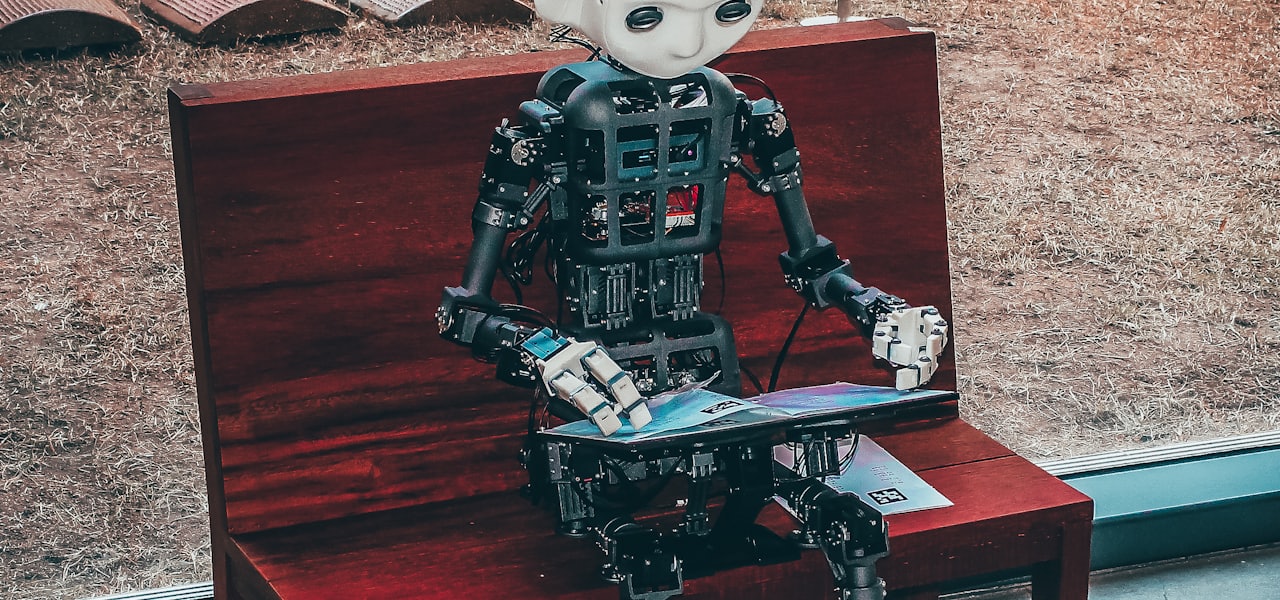
Open-source robotics is a branch of robotics where robots are developed with open-source hardware and free and open-source software, publicly sharing blueprints, schematics, and source code. It is thus closely related to the open design movement, the maker movement and open science. == Requirements == Open source robotics means that information about the hardware is easily discerned, so that others can easily rebuild it. In turn, this requires design to use only easily available standard subcomponents and tools, and for the build process to be documented in detail including a bill of materials and detailed ('Ikea style') step-by-step building and testing instructions. (A CAD file alone is not sufficient, as it does not show the steps for performing or testing the build). These requirements are standard to open source hardware in general, and are formalised by various licences, certifications, especially those defined by the peer-reviewed journals Journal of Open Hardware and HardwareX. Licensing requirements for software are the same as for any open source software. But in addition, for software components to be of practical use in real robot systems, they need to be compatible with other software, usually as defined by some robotics middleware community standard. == Hardware systems == Applications to date include: Robot arms, e.g. PARA or Thor Wheeled mobile robots. e.g. OpenScout Four-legged robots such as the Open Dynamic Robot Initiative UAV quadcopters (drones) such as Agilicious Humanoid robots, e.g. iCub, Berkeley Humanoid Lite Self-driving cars, e.g. OpenPodcar (→ Personal rapid transit) Submersible robots, eg. OpenFish Laboratory robotics such as chemical liquid handling Vertical farming Swarm robots, e.g. HeRoSwarm Domestic tasks: vacuum cleaning, floor washing and grass mowing Robot sports including robot combat and autonomous racing Education == Hardware subcomponents == Most open source hardware definitions allow non-open subcomponents to be used in modular design, as long as they are easily available. However many designs try to push openness down into as many subcomponents as possible, with the aim of ultimately reaching fully open designs. Open hardware manual-drive vehicles and their subcomponents, such as from Open Source Ecology, are often used as starting points and extended with automation systems. Open subcomponents can include open-source computing hardware as subcomponents, such as Arduino and RISC-V, as well as open source motors and drivers such as the Open Source Motor Controller and ODrive. Open hardware robotics interface boards can simplify interfacing between middleware software and physical hardware. == Software subcomponents == === Middleware === Robotics middleware is software which links multiple other software components together. In robotics, this specifically means real-time communication systems with standardized message passing protocols. The predominant open source middleware is ROS2, the robot operating system, now as version 2. Other alternatives include ROS1, YARP — used in the iCub, URBI, and Orca. Open source middleware is usually run on an open source operating system, especially the Ubuntu distribution of Linux. === Driver software === Most robot sensors and actuators require software drivers. There is little standardization of open source software at this level, because each hardware device is different. Creating open drivers for closed hardware is difficult as it requires both low level programming and reverse engineering. === Simulation software === Open source robotics simulators include Gazebo, MuJoCo and Webots. Open source 3D game engines such as Godot are also sometimes used as simulators, when equipped with suitable middleware interfaces. === Automation software === At the level of AI, many standard algorithms have open source software implementations, mostly in ROS2. Major components include: Machine vision systems such as the YOLO object detector. 3D photogrammetry Navigation including SLAM and planning such as nav2 Arm inverse kinematics such as moveIt2 == Community == The first signs of the increasing popularity of building and sharing robot designs were found with the maker culture community. What began with small competitions for remote operated vehicles (e.g. Robot combat), soon developed to the building of autonomous telepresence robots such as Sparky and then true robots (being able to take decisions themselves) as the Open Automaton Project. Several commercial companies now also produce kits for making simple robots. The community has adopted open source hardware licenses, certifications, and peer-reviewed publications, which check that source has been made correctly and permanently available under community definitions, and which validate that this has been done. These processes have become critically important due to many historical projects claiming to be open source but them reverting on the promise due to commercialisation or other pressures. As with other forms of open source hardware, the community continues to debate precise criteria for 'ease of build'. A common standard is that designs should be buildable by a technical university student, in a few days, using typical fablab tools, but definitions of all of these subterms can also be debated. Compared to other forms of open source hardware, open source robotics typically includes a large software element, so involves software as well as hardware engineers. Open source concepts are more established in open source software than hardware, so robotics is a field in which those concepts can be shared and transferred from software to hardware. While the community in open source robotics is multi-faceted with a wide range of backgrounds, a sizable sub-community uses the ROS middleware and meets at the ROSCon conferences to discuss development of ROS itself and automation components built on it.